

Lessons Learned
[Originally published in The Nation, 20 August 2006]
Hours before the UN ceasefire went into effect, Israel quietly announced that it would, after all, be willing to negotiate a prisoner exchange with Hezbollah to secure the return of the two soldiers whose capture sparked the recent war.
Had Israel accepted Hezbollah's offer of a negotiated exchange five weeks ago, more than 1,000 people--the vast majority Lebanese civilians--would still be alive. In addition, more than a million people would not have been displaced from their homes; entire neighborhoods in Beirut and whole villages in the south of Lebanon would still be intact; and the Israeli army would not have reduced Lebanon to an environmentally devastated wasteland.
Rather than negotiating an exchange (as they have in the past), the Israelis launched a wave of air and artillery attacks on civilian targets in Lebanon.
When Hezbollah retaliated with several salvos of rockets, Israel angrily announced that no country--other than Lebanon, presumably--can tolerate such attacks, and it stepped up its bombardment of Lebanon, striking the international airport in Beirut as well as other civilian targets, and threatening to set the entire country back twenty years.
Far too many people in the US accepted Israel's claims at face value.
Hardly anyone bothered to put the capture of the Israeli soldiers (which was referred to as a "kidnapping," not a term normally used with reference to soldiers in wartime) in historical context. It was depicted as having come out of the blue, rather than being understood as one event in a continuous series originating with Israel's invasion of Lebanon in 1982-in whose aftermath Hezbollah was born. When the rockets started flying, no one seemed to notice that Israel had brought punishment on its own civilians by having chosen to respond disproportionately to a minor border skirmish, and to an attack on its army by bombing defenseless civilians.
Overnight, as the captured soldiers faded into the background, a consensus seemed to emerge in the US, according to which the bombing of Lebanon was really about Israel's need to protect its northern border from Hezbollah rocket attacks.
We were saturated with the message that Hezbollah is a shadowy terrorist organization that has spent years showering northern Israel with rockets--and that Israel had both the right and the duty to protect itself from such attacks once and for all. Thus was history instantaneously rewritten to Israel's own specifications.
In fact, from the moment that Israel ended its last military occupation of Lebanon in 2000 until the explosion of the current war on July 12, UN observers report that there was not a single casualty as a result of a confirmed rocket attack by Hezbollah on civilian targets in northern Israel.
A number of alternative explanations for Israel's bombardment of Lebanon have been proposed, most of them involving the Bush administration's regional ambitions. It may have been another attempt to create "a new Middle East," or, as Seymour Hersh suggests, it may have been a dress rehearsal for a future US war on Iran.
Whatever its real motivations, however, Israel failed. For all the damage it inflicted on innocent civilians, Israel's lumbering army was resolutely beaten back by Hezbollah.
We may never know the real reasons for Israel's attack, but there are lessons to be learned from the past few weeks of violence.
First, we should learn never to accept at face value any government's justifications for its own actions. Government claims need to be viewed skeptically, placed in context, read against the grain.
Second, we need to learn not to assess Israel's actions using Israel's own discourse. Not only, for example, do hundreds of millions of people not see Hezbollah as a terrorist organization, but to accept the Israeli designation is to ignore the material fact that Hezbollah is a massive social movement that gained prominence by resisting what would have been recognized in any other context as a brutal and illegal military occupation.
Third, it is essential for us to disentangle American interests from Israeli ones. Our government supported Israel's war on Lebanon. We financed and supplied it; our Congress affirmed it; our representatives repeatedly blocked international appeals for a ceasefire that would have saved hundreds of lives. It is childish for us to imagine that we will not have further prices to pay for our blind support for Israel. We should demand from our government an explanation of what we receive in turn--especially if that is nothing.
Finally, we must learn to see Israel for what it is. A state that punishes an entire population, flouts international law, commits war crimes, refuses to allow aid to reach beleaguered civilians, destroys ambulances, attacks civilians, and orders terrified people from their homes only to bomb them as they flee, is a rogue state. We need to ask ourselves what we gain by associating ourselves with it.
Monday, August 21, 2006


Monday, August 7, 2006
Israel Should Call it Quits
Israel's Raid on Baalbeck's Hospital: Time to call it Quits
[Originally published by Saree Makdisi in Counterpunch, 3 August 2006]
Israeli commandos staged a daring raid the other night on the ancient Lebanese town of Baalbeck, catching Hassan Nasrallah asleep, bundling him into a waiting helicopter, and spiriting him back to Israel.
But as the dust settled and reports from the ground began to emerge, it turned out that the Hassan Nasrallah that Israel's most elite military unit had captured-with the assistance of the formidable intelligence capabilities of the legendary Mossad-was apparently not Hassan Nasrallah, the leader of Hizballah, but rather Hassan Nasrallah, the owner of a small toyshop on the dusty outskirts of Baalbeck. They also nabbed his son, another relative, and a neighbor for good measure. Israel claims that the men are members of Hizballah, albeit not the ones they were hoping for. Their relatives and neighbors, and Hizballah itself, deny this.
The raid was focused on the Dar al Hikma hospital, which was heavily damaged by the Israeli raiders and supporting fire from aircraft. The hospital, however, was found to be empty. The kidnapped men were, according to local sources, taken from their homes.
To provide cover before and during the raid on the hospital, Israeli aircraft subjected residential neighborhoods of Baalbeck and neighboring towns to a withering bombardment, in which seventeen people, almost all of them civilians, were killed. The dead included the son of the mayor of al Jamaliyeh, his brother, and five other relatives. The mayor of al Jamaliyeh, incidentally, held a distinctly anti-Hizballah position in local politics.
Israel's aerial torment of a population entirely lacking in air defenses and even proper air raid shelters has now killed some 900 people, the overwhelming majority of them civilians, and about a third of them children. It has displaced almost a million people from their homes. It has devastated Lebanon's civilian infrastructure. It has reduced entire towns in the south-including Bint Jbeil, once home to 30,000 people-to rubble. And it has left block after block after block of Beirut in total ruins. (All this while Israel is at the same time holding the 1.4 million destitute people of the Gaza Strip in the world's largest prison, bombarding them day and night, and sadistically depriving them of sleep at night by repeatedly breaking the sound barrier at low altitude).
After three weeks of devastating bombardment, Israel's much vaunted army finds itself unable to fight its way more than a few kilometers into Lebanon. The heavy resistance they have encountered on the ground is the most obvious explanation for why the Israelis prefer on the whole to go on dropping bombs on children from a safe distance: not only is it less dangerous, it also involves much less effort.
The "deep penetration" raid on Baalbeck was meant to show off the capabilities of Israel's armed forces, to make up for their humiliating performance on the ground and their repeated massacres of civilians from the air, including the refugees sheltering in Qana (an event whose cover story has gone through at least three variations, none of them convincing to anyone other than the Israelis themselves).
Instead, it left a hospital in ruins, more than a dozen civilians dead, and elite forces in possession of an unfortunate middle-aged shopkeeper and an assortment of his friends and relatives.
Surely this would be the right moment for Israel to give up and call it quits
[Originally published by Saree Makdisi in Counterpunch, 3 August 2006]
Israeli commandos staged a daring raid the other night on the ancient Lebanese town of Baalbeck, catching Hassan Nasrallah asleep, bundling him into a waiting helicopter, and spiriting him back to Israel.
But as the dust settled and reports from the ground began to emerge, it turned out that the Hassan Nasrallah that Israel's most elite military unit had captured-with the assistance of the formidable intelligence capabilities of the legendary Mossad-was apparently not Hassan Nasrallah, the leader of Hizballah, but rather Hassan Nasrallah, the owner of a small toyshop on the dusty outskirts of Baalbeck. They also nabbed his son, another relative, and a neighbor for good measure. Israel claims that the men are members of Hizballah, albeit not the ones they were hoping for. Their relatives and neighbors, and Hizballah itself, deny this.
The raid was focused on the Dar al Hikma hospital, which was heavily damaged by the Israeli raiders and supporting fire from aircraft. The hospital, however, was found to be empty. The kidnapped men were, according to local sources, taken from their homes.
To provide cover before and during the raid on the hospital, Israeli aircraft subjected residential neighborhoods of Baalbeck and neighboring towns to a withering bombardment, in which seventeen people, almost all of them civilians, were killed. The dead included the son of the mayor of al Jamaliyeh, his brother, and five other relatives. The mayor of al Jamaliyeh, incidentally, held a distinctly anti-Hizballah position in local politics.
Israel's aerial torment of a population entirely lacking in air defenses and even proper air raid shelters has now killed some 900 people, the overwhelming majority of them civilians, and about a third of them children. It has displaced almost a million people from their homes. It has devastated Lebanon's civilian infrastructure. It has reduced entire towns in the south-including Bint Jbeil, once home to 30,000 people-to rubble. And it has left block after block after block of Beirut in total ruins. (All this while Israel is at the same time holding the 1.4 million destitute people of the Gaza Strip in the world's largest prison, bombarding them day and night, and sadistically depriving them of sleep at night by repeatedly breaking the sound barrier at low altitude).
After three weeks of devastating bombardment, Israel's much vaunted army finds itself unable to fight its way more than a few kilometers into Lebanon. The heavy resistance they have encountered on the ground is the most obvious explanation for why the Israelis prefer on the whole to go on dropping bombs on children from a safe distance: not only is it less dangerous, it also involves much less effort.
The "deep penetration" raid on Baalbeck was meant to show off the capabilities of Israel's armed forces, to make up for their humiliating performance on the ground and their repeated massacres of civilians from the air, including the refugees sheltering in Qana (an event whose cover story has gone through at least three variations, none of them convincing to anyone other than the Israelis themselves).
Instead, it left a hospital in ruins, more than a dozen civilians dead, and elite forces in possession of an unfortunate middle-aged shopkeeper and an assortment of his friends and relatives.
Surely this would be the right moment for Israel to give up and call it quits
US Should not Abet Violence in Lebanon
The US Should not Abet Violence in Lebanon
[Originally published by Saree Makdisi in the Cleveland Plain Dealer, 22 July 2006]
Never has the gulf between U.S. and Israeli interests been clearer than during the present crisis. And not since the shameful coverup of the 1967 Israeli bombing of the USS Liberty - in which 34 Navy crewmen were killed - have our politicians done so much to protect Israel's interests at the expense of our own.
We have not been standing idly by as Israel destroys Lebanon's civilian infrastructure, obliterates entire neighborhoods and kills dozens of innocent people.
Not only has our government provided Israel with the weapons with which it is now bombarding Lebanon, it also has provided virtually unlimited financial, military, political and diplomatic support to enable - even encourage - Israel to continue.
Our government intervened to remove criticism of Israel from the G-8 Summit statement on the crisis. It stymied European efforts to call for a cease-fire to protect civilian life. It vetoed a U.N. resolution calling on Israel to stop its attack on Gaza's civilians. It rushed an additional $210 million of aviation fuel to Israel to help it "keep peace and security in the region." And it even granted Israel an additional week to continue its unrestrained pounding of Lebanon, according to diplomatic reports.
Lebanon is facing a humanitarian catastrophe; 335 people have been killed. The United Nations estimates that up to half a million people have been displaced from their homes. With Israel having reduced Lebanon to a large-scale version of Gaza - cut off from the outside world, denied water and electricity, unable to import essential supplies of food and medicine - the country is on its knees. Four million people are now not merely terrified, but increasingly hungry and thirsty.
It is absurd to consider this level of violence a legitimate act of self-defense. During its war with the IRA, Britain could have used the same argument to destroy Ireland's roads, bridges, ports and airports on the pretext that they were being used by the IRA to move weapons and supplies; it could have used it to launch massive bombardments of Catholic neighborhoods both in the Republic and in Northern Ireland.
The absurdity of the justification aside, Israel has bombed targets in Lebanon that have no possible connection to Hezbollah. It has killed sleeping Lebanese army soldiers in the north of the country, even though the Lebanese army is not involved in the conflict and is, moreover, supposed to be the key to the solution, according to Israel itself. It has bombed milk factories, cutting off the supply of a vital nutrient to Lebanon's babies and children. It has bombed a desperately needed aid convoy heading toward Beirut from the United Arab Emirates. It has bombed hospitals, schools and ambulances. All of this, of course, is in blatant violation of the U.S. Arms Export Control Act, under which our weapons are provided to Israel.
Why is our country supporting Israel's unlimited violence not only against an entire population, but a population that has historically been the most friendly to the United States in the entire Arab world? For decades, America has been a beacon of hope and liberty to the people of Lebanon. Its foremost university is an American institution. Its people have emigrated in tens of thousands to America (the majority of Arab-Americans are Lebanese), tying our two nations together.
Justice aside, what do we gain from the bombing of these people?
Are we really to believe that this attack will destroy Hezbollah? Israel enforced a draconian military occupation of Lebanon for over two decades; just as it failed to destroy Hezbollah then, it will fail again now.
Are we then to believe that this attack constitutes a slap in the face for Iran and Syria? The destruction of Lebanon's infrastructure hurts neither of them. On the contrary, it will provide them another chance to give generously during reconstruction.
This attack has nothing to do with Israel's self defense. Preparing for eventual negotiations, it is showing how it deals with those who dare question it: It reduces their country to rubble. In the name of combating one form of extremism, we are backing another - Israel's.
We gain nothing in the process. But we will pay a price.
Three hundred million Arabs and 1 billion Muslims are watching as one rational and peaceful and moral argument after another to restore peace is either denied or deflected or contemptuously spurned by our leaders in order to allow Israel to continue its bombardment. The next time one or three or 10 of them take it in their heads to launch a horrific attack on the United States - which they will regard as justified retribution - no one need bother to ask why they hate us. We will all know the answer.
[Originally published by Saree Makdisi in the Cleveland Plain Dealer, 22 July 2006]
Never has the gulf between U.S. and Israeli interests been clearer than during the present crisis. And not since the shameful coverup of the 1967 Israeli bombing of the USS Liberty - in which 34 Navy crewmen were killed - have our politicians done so much to protect Israel's interests at the expense of our own.
We have not been standing idly by as Israel destroys Lebanon's civilian infrastructure, obliterates entire neighborhoods and kills dozens of innocent people.
Not only has our government provided Israel with the weapons with which it is now bombarding Lebanon, it also has provided virtually unlimited financial, military, political and diplomatic support to enable - even encourage - Israel to continue.
Our government intervened to remove criticism of Israel from the G-8 Summit statement on the crisis. It stymied European efforts to call for a cease-fire to protect civilian life. It vetoed a U.N. resolution calling on Israel to stop its attack on Gaza's civilians. It rushed an additional $210 million of aviation fuel to Israel to help it "keep peace and security in the region." And it even granted Israel an additional week to continue its unrestrained pounding of Lebanon, according to diplomatic reports.
Lebanon is facing a humanitarian catastrophe; 335 people have been killed. The United Nations estimates that up to half a million people have been displaced from their homes. With Israel having reduced Lebanon to a large-scale version of Gaza - cut off from the outside world, denied water and electricity, unable to import essential supplies of food and medicine - the country is on its knees. Four million people are now not merely terrified, but increasingly hungry and thirsty.
It is absurd to consider this level of violence a legitimate act of self-defense. During its war with the IRA, Britain could have used the same argument to destroy Ireland's roads, bridges, ports and airports on the pretext that they were being used by the IRA to move weapons and supplies; it could have used it to launch massive bombardments of Catholic neighborhoods both in the Republic and in Northern Ireland.
The absurdity of the justification aside, Israel has bombed targets in Lebanon that have no possible connection to Hezbollah. It has killed sleeping Lebanese army soldiers in the north of the country, even though the Lebanese army is not involved in the conflict and is, moreover, supposed to be the key to the solution, according to Israel itself. It has bombed milk factories, cutting off the supply of a vital nutrient to Lebanon's babies and children. It has bombed a desperately needed aid convoy heading toward Beirut from the United Arab Emirates. It has bombed hospitals, schools and ambulances. All of this, of course, is in blatant violation of the U.S. Arms Export Control Act, under which our weapons are provided to Israel.
Why is our country supporting Israel's unlimited violence not only against an entire population, but a population that has historically been the most friendly to the United States in the entire Arab world? For decades, America has been a beacon of hope and liberty to the people of Lebanon. Its foremost university is an American institution. Its people have emigrated in tens of thousands to America (the majority of Arab-Americans are Lebanese), tying our two nations together.
Justice aside, what do we gain from the bombing of these people?
Are we really to believe that this attack will destroy Hezbollah? Israel enforced a draconian military occupation of Lebanon for over two decades; just as it failed to destroy Hezbollah then, it will fail again now.
Are we then to believe that this attack constitutes a slap in the face for Iran and Syria? The destruction of Lebanon's infrastructure hurts neither of them. On the contrary, it will provide them another chance to give generously during reconstruction.
This attack has nothing to do with Israel's self defense. Preparing for eventual negotiations, it is showing how it deals with those who dare question it: It reduces their country to rubble. In the name of combating one form of extremism, we are backing another - Israel's.
We gain nothing in the process. But we will pay a price.
Three hundred million Arabs and 1 billion Muslims are watching as one rational and peaceful and moral argument after another to restore peace is either denied or deflected or contemptuously spurned by our leaders in order to allow Israel to continue its bombardment. The next time one or three or 10 of them take it in their heads to launch a horrific attack on the United States - which they will regard as justified retribution - no one need bother to ask why they hate us. We will all know the answer.
Wednesday, July 19, 2006
Israel's Outrageous Attacks
Israel's Outrageous Attacks
Its blanket bombardment of Lebanon amounts to collective guilt.
[Originally published by Saree Makdisi in The Los Angeles Times, 19 July 2006]
APPARENTLY suffering from amnesia, Israel now says that its extraordinary collective punishment of the entire Lebanese population is intended to stop rocket attacks across its northern border.
However, Israel's blanket bombardment of Lebanon was sparked not by rockets (which came in retaliation) but by a guerrilla operation against a military target, the aim of which was to capture soldiers as leverage for the release of some of the Lebanese prisoners Israel stubbornly refuses to free. Israel itself has repeatedly crossed into Lebanon to capture prisoners — including civilians — for use as bargaining chips.
Indeed, although captures, negotiations and exchanges have long been part of Israel's relationship with Hezbollah, this time it categorically refused to negotiate the release of its soldiers — preferring instead to pummel hundreds of thousands of defenseless people on a scale out of all proportion to what it regards as the initial provocation.
So far, Israel has killed more than 230 people — all but a handful of whom were civilians — including whole families. With its customary arrogance, it has issued peremptory warnings to entire communities to get out of its way or face the consequences: terrorism in the true sense of the word. It gave the residents of the town of Marwaheen in southern Lebanon, for example, a few hours to leave their homes. The terrified residents came under Israeli fire as they fled. More than 15 people, most of them children, were killed.
Israel later warned the entire population of southern Lebanon to leave. No Arab can forget that terrorizing an entire population from its homes is the tactic that was used to seize possession of Palestine in the spring and summer of 1948. Not everyone will leave. Many will reject Israel's imperious warnings — what right, they will ask, does Israel have to terrify us into flight from our homes? In any case, most of them have nowhere to flee to — and even if they did, Israel has destroyed the bridges and is bombing the roads out of the south.
In a week of vindictive bombardment, Israel has destroyed the infrastructure that Lebanon spent a decade building. Under the cover of misleading headlines, such as one that read "Israel Pounds Hezbollah Strongholds," Israel has in fact bombed towns and villages, provincial centers and Beirut.
Israel has killed Christians, Sunnis and Shiites, old and young, men and women, from the great Phoenician cities of Sidon and Tyre to more humble towns — Chtoura and Juniyah, Damour and Naame, Jiye and Baalbek, Khiam and Batrun.
It has wrecked roads, bridges, a lighthouse, ports, tunnels, electrical pylons, water mains, fuel depots, gas stations, power plants, houses, shops, schools — and even a milk factory. It has repeatedly blasted the international airport that was the symbol of Lebanon's rebirth from 15 years of war.
Where, when or if Lebanon will ever get the funding to rebuild what Israel has smashed remain open questions. When Israel finally relents, it will leave Lebanon without a functioning infrastructure — and the lives of nearly 4 million people altered beyond recognition.
That, of course, is explicitly the point of this outrage. Israel's army chief bragged that he would set Lebanon back "20 years." That is what is happening — as a silent world watches.
http://www.latimes.com/news/opinion/commentary/la-oe-makdisi19jul19,0,4920124.story?coll=la-opinion-center
Its blanket bombardment of Lebanon amounts to collective guilt.
[Originally published by Saree Makdisi in The Los Angeles Times, 19 July 2006]
APPARENTLY suffering from amnesia, Israel now says that its extraordinary collective punishment of the entire Lebanese population is intended to stop rocket attacks across its northern border.
However, Israel's blanket bombardment of Lebanon was sparked not by rockets (which came in retaliation) but by a guerrilla operation against a military target, the aim of which was to capture soldiers as leverage for the release of some of the Lebanese prisoners Israel stubbornly refuses to free. Israel itself has repeatedly crossed into Lebanon to capture prisoners — including civilians — for use as bargaining chips.
Indeed, although captures, negotiations and exchanges have long been part of Israel's relationship with Hezbollah, this time it categorically refused to negotiate the release of its soldiers — preferring instead to pummel hundreds of thousands of defenseless people on a scale out of all proportion to what it regards as the initial provocation.
So far, Israel has killed more than 230 people — all but a handful of whom were civilians — including whole families. With its customary arrogance, it has issued peremptory warnings to entire communities to get out of its way or face the consequences: terrorism in the true sense of the word. It gave the residents of the town of Marwaheen in southern Lebanon, for example, a few hours to leave their homes. The terrified residents came under Israeli fire as they fled. More than 15 people, most of them children, were killed.
Israel later warned the entire population of southern Lebanon to leave. No Arab can forget that terrorizing an entire population from its homes is the tactic that was used to seize possession of Palestine in the spring and summer of 1948. Not everyone will leave. Many will reject Israel's imperious warnings — what right, they will ask, does Israel have to terrify us into flight from our homes? In any case, most of them have nowhere to flee to — and even if they did, Israel has destroyed the bridges and is bombing the roads out of the south.
In a week of vindictive bombardment, Israel has destroyed the infrastructure that Lebanon spent a decade building. Under the cover of misleading headlines, such as one that read "Israel Pounds Hezbollah Strongholds," Israel has in fact bombed towns and villages, provincial centers and Beirut.
Israel has killed Christians, Sunnis and Shiites, old and young, men and women, from the great Phoenician cities of Sidon and Tyre to more humble towns — Chtoura and Juniyah, Damour and Naame, Jiye and Baalbek, Khiam and Batrun.
It has wrecked roads, bridges, a lighthouse, ports, tunnels, electrical pylons, water mains, fuel depots, gas stations, power plants, houses, shops, schools — and even a milk factory. It has repeatedly blasted the international airport that was the symbol of Lebanon's rebirth from 15 years of war.
Where, when or if Lebanon will ever get the funding to rebuild what Israel has smashed remain open questions. When Israel finally relents, it will leave Lebanon without a functioning infrastructure — and the lives of nearly 4 million people altered beyond recognition.
That, of course, is explicitly the point of this outrage. Israel's army chief bragged that he would set Lebanon back "20 years." That is what is happening — as a silent world watches.
http://www.latimes.com/news/opinion/commentary/la-oe-makdisi19jul19,0,4920124.story?coll=la-opinion-center
Saturday, July 15, 2006
No Peace for Israel without Justice for Palestinians
No Peace for Israel without Justice for Palestinians
[Originally published by Saree Makdisi in the Houston Chronicle, 14 July 2006]
The civilian infrastructure — notably Beirut International Airport — was the first target of the attack that Israel unleashed on Lebanon in response to the capture of two Israeli soldiers this week.
This mimicks Israel's earlier assaults on the essentially defenseless population of the Gaza Strip. Israeli missiles destroyed Gaza's only power plant, depriving half the population of electricity for the hot summer months (no fans, no fridges, no light after sunset). Israeli interdictions severely disrupted supplies of food, fuel, medicines and water. Midnight air raids, artillery bombardments, and sleep deprivation are taking a psychological toll, particularly on young children.
Israel is, in short, now punishing more than a million men, women and children in Gaza for a Palestinian guerrilla attack on an Israeli army post (an obviously military target), and the entire population of Lebanon for a Hezbollah attack on Israeli troops on its northern border.
As Israel lashes out indiscriminately, mocking international law, U.S. government officials and prominent pundits have expressed sympathy — not for the victims of these attacks, but for their perpetrators. Moreover, much of the arsenal that Israel uses against Lebanese and Palestinians is American, including the armored bulldozers it uses to crush homes, the missiles recklessly fired into crowded neighborhoods and the gunships that launch them.
Such support tarnishes U.S. standing in a strategically vital region of the world. More and more Americans realize that we pay a price for Israel's abuses — and receive nothing in return.
What we most urgently need to know is that the tragedy now unfolding in Gaza is not merely one more episode in a supposed "cycle of violence" (which implies proportionality), let alone a genuine military contest (for only one side has an army).
But if the current Israeli attacks are utterly disproportionate to their alleged provocations, that is because far more is at stake than Palestinian pinpricks. What is happening in Gaza is an expression of Israel's political vision.
Israeli politicians speak openly of that vision (indeed, the current Israeli government won recent elections with a pledge to fulfill it): the consolidation of a state with a Jewish majority in a land in which barely half the population is actually Jewish.
There is no way to implement such a program without violence. That was the case in 1948, when half of Palestine's non-Jewish population was driven into flight — never to be allowed to return — in order for a Jewish state to be created on what had been Palestinians' land. And it is the case today, as Israel seeks to forcibly isolate the land's remaining non-Jewish population into barren islands cut off from each other and the rest of the world.
Gaza is only one of these islands. The others are in the West Bank which, with Gaza and east Jerusalem, are what remained of Palestine after it was dismembered in 1948 — only to be captured by Israel in 1967.
Jerusalem is already off limits to most Palestinians. Israel has broken the West Bank into three separate cantons. A grid of roadblocks further fragments each canton internally. Israel's separation barrier only adds to the fragmentation, as do a road network barred to Palestinians — and a sprawling array of illegal Jewish settlements — whose annexation to Israel, while bypassing areas of indigenous, non-Jewish population, is Israel's objective.
Israel claims to hold the Palestinian "government" accountable for the raid on its Gaza outpost. But this archipelago of besieged territories does not — and it will never — amount to a "state." It is designed to be a collection of open-air holding cells for the land's non-Jewish population: spaces to detain them, isolate them from health-care, educational and infrastructural services, deny them access to land, resources and markets, until they either die or simply give up and go away. Gaza's suffocation over the past year illustrates this perfectly.
Each departing Palestinian will be triumphantly checked off the tally by Israeli demographers like Arnon Sofer who, anxiously monitoring what they unabashedly call the "demographic threat" to their country, obsessively calculate ratios of Jews to non-Jews.
Lacking an army, Palestinians do not pose a material challenge to Israel. They pose an ideological challenge. Raids like the one on the Gaza outpost remind Israelis that the Palestinians will not go away; this is why Israel cannot tolerate them.
Israel's announcement that it now intends to create by force a depopulated "security zone" in northern Gaza is eerily reminiscent of its futile attempt to enforce such a zone in southern Lebanon. Israel's northern border fell silent — not when it had finally used enough violence against Lebanon — but when it decided to end its illegal military occupation of Lebanese territory. That lesson has apparently been forgotten already, as Israel again holds an entire country hostage.
The same principle applies to Gaza. Israel's use of overwhelming force against civilian targets shows that it still fails to understand that occupation begets resistance — and that peace for Israelis is inseparable from justice for Palestinians.
These are lessons that Americans should learn as well.
HoustonChronicle.com -- http://www.HoustonChronicle.com Section: Viewpoints, Outlook
[Originally published by Saree Makdisi in the Houston Chronicle, 14 July 2006]
The civilian infrastructure — notably Beirut International Airport — was the first target of the attack that Israel unleashed on Lebanon in response to the capture of two Israeli soldiers this week.
This mimicks Israel's earlier assaults on the essentially defenseless population of the Gaza Strip. Israeli missiles destroyed Gaza's only power plant, depriving half the population of electricity for the hot summer months (no fans, no fridges, no light after sunset). Israeli interdictions severely disrupted supplies of food, fuel, medicines and water. Midnight air raids, artillery bombardments, and sleep deprivation are taking a psychological toll, particularly on young children.
Israel is, in short, now punishing more than a million men, women and children in Gaza for a Palestinian guerrilla attack on an Israeli army post (an obviously military target), and the entire population of Lebanon for a Hezbollah attack on Israeli troops on its northern border.
As Israel lashes out indiscriminately, mocking international law, U.S. government officials and prominent pundits have expressed sympathy — not for the victims of these attacks, but for their perpetrators. Moreover, much of the arsenal that Israel uses against Lebanese and Palestinians is American, including the armored bulldozers it uses to crush homes, the missiles recklessly fired into crowded neighborhoods and the gunships that launch them.
Such support tarnishes U.S. standing in a strategically vital region of the world. More and more Americans realize that we pay a price for Israel's abuses — and receive nothing in return.
What we most urgently need to know is that the tragedy now unfolding in Gaza is not merely one more episode in a supposed "cycle of violence" (which implies proportionality), let alone a genuine military contest (for only one side has an army).
But if the current Israeli attacks are utterly disproportionate to their alleged provocations, that is because far more is at stake than Palestinian pinpricks. What is happening in Gaza is an expression of Israel's political vision.
Israeli politicians speak openly of that vision (indeed, the current Israeli government won recent elections with a pledge to fulfill it): the consolidation of a state with a Jewish majority in a land in which barely half the population is actually Jewish.
There is no way to implement such a program without violence. That was the case in 1948, when half of Palestine's non-Jewish population was driven into flight — never to be allowed to return — in order for a Jewish state to be created on what had been Palestinians' land. And it is the case today, as Israel seeks to forcibly isolate the land's remaining non-Jewish population into barren islands cut off from each other and the rest of the world.
Gaza is only one of these islands. The others are in the West Bank which, with Gaza and east Jerusalem, are what remained of Palestine after it was dismembered in 1948 — only to be captured by Israel in 1967.
Jerusalem is already off limits to most Palestinians. Israel has broken the West Bank into three separate cantons. A grid of roadblocks further fragments each canton internally. Israel's separation barrier only adds to the fragmentation, as do a road network barred to Palestinians — and a sprawling array of illegal Jewish settlements — whose annexation to Israel, while bypassing areas of indigenous, non-Jewish population, is Israel's objective.
Israel claims to hold the Palestinian "government" accountable for the raid on its Gaza outpost. But this archipelago of besieged territories does not — and it will never — amount to a "state." It is designed to be a collection of open-air holding cells for the land's non-Jewish population: spaces to detain them, isolate them from health-care, educational and infrastructural services, deny them access to land, resources and markets, until they either die or simply give up and go away. Gaza's suffocation over the past year illustrates this perfectly.
Each departing Palestinian will be triumphantly checked off the tally by Israeli demographers like Arnon Sofer who, anxiously monitoring what they unabashedly call the "demographic threat" to their country, obsessively calculate ratios of Jews to non-Jews.
Lacking an army, Palestinians do not pose a material challenge to Israel. They pose an ideological challenge. Raids like the one on the Gaza outpost remind Israelis that the Palestinians will not go away; this is why Israel cannot tolerate them.
Israel's announcement that it now intends to create by force a depopulated "security zone" in northern Gaza is eerily reminiscent of its futile attempt to enforce such a zone in southern Lebanon. Israel's northern border fell silent — not when it had finally used enough violence against Lebanon — but when it decided to end its illegal military occupation of Lebanese territory. That lesson has apparently been forgotten already, as Israel again holds an entire country hostage.
The same principle applies to Gaza. Israel's use of overwhelming force against civilian targets shows that it still fails to understand that occupation begets resistance — and that peace for Israelis is inseparable from justice for Palestinians.
These are lessons that Americans should learn as well.
HoustonChronicle.com -- http://www.HoustonChronicle.com Section: Viewpoints, Outlook
Tuesday, October 11, 2005
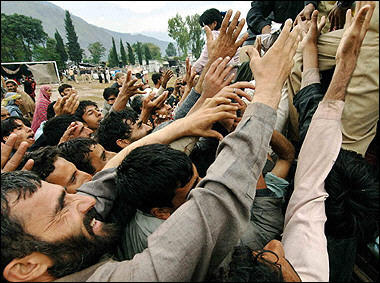
Our Brothers and Sisters from Guatemala, Pakistan, India and New Orleans Need Your Help
You can give whatever you have. you can give clothes or money. Actually, money is very helpful. The rescuers can use it to buy necessary items right on the site. Do whatever you can to help your neighbors.



Saturday, October 8, 2005

Subscribe to:
Posts (Atom)


